

You can increase yield by sowing seeds earlier if you can manage the risk. You may be able to start early and squeeze in another production cycle, but if you start too early and you suffer an early frost, then you’re way behind. What if you had a way to quantify the risk? What if you had real-time soil data in the spring that lets you know when it’s safe to start planting? This article will dig into approaches we have been discussing with our users based on a case study from Alberta Agriculture and Forestry.
A case study from Alberta Agriculture and Forestry on soil temperature and direct seeding vs conventional tillage, explains the impact of a slight variance in soil temperature on total yield. Conventional tillage soils can get warmer a bit early in springtime, allowing the extra few days for sowing. The temperature variance can be checked accurately through temperature sensors like Standard Sensor Solution.
Many growers (especially organic growers) rely on microbiology for nutrient availability during germination. The microorganisms in soil are usually active at about 10C or higher and can be closely monitored in the spring. Some growers consider monitoring soil temperature more useful than monitoring air temperature when determining when to start sowing seeds. You can potentially start the season earlier if you know and use soil temperature data with real-time data; rather than relying on air temperature alone to determine the right time to start.
A case study on soil temperature and direct seeding vs conventional tillage, explains the big impact of even a slight variance in soil temperature on total yield. Conventionally tilling soils allows the soil to warm up earlier in the spring, allowing the extra few days for sowing. The temperature variance can be checked accurately using a soil temperature sensor like that supplied with the Connectedcrops Standard Sensor Solution.
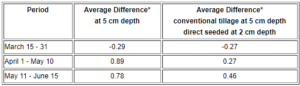
Table 1 shows that conventionally tilled soils get warmer early on for early sowing as compared to direct seeding.
Table 1. Spring temperature differences between conventionally tilled and direct seeded soils

Seeds of most major crops grown in Alberta (cereals, Argentine canola, pulses) begin to germinate at temperatures as low as 3 to 5°C. By sowing early, crop maturity can be sped up depending on the summer growing season conditions.
CONCLUSION
You can manage cooler seedbeds by evenly spreading crop residues and shallower seeding. The soil temperature can be effectively monitored to sow early in the season and speed up the maturity to provide extra days for fruition.
ConnectedCrops has a complete solution to increase crop yield by purely monitoring soil temperature and moisture. You no longer have to rely on guesswork and historical data. You can know the exact soil temperature at different depths and sow your crops early. In addition to this, the soil moisture levels can be monitored and controlled to irrigate flowering crops more accurately.
ConnectedCrops sensors for soil moisture and soil temperature provide a full solution for farmers to know when to sow seeds and when to irrigate the most.