Low Production Risks- How to optimize irrigation systems?

  • After a rainfall, how do you know how much water stays in your field?  How long does it stay before it drains from the surface level?  How quickly is it absorbed by your crops?
  • Is my irrigation system optimized for a better yield?

If you knew how much water stayed in the field, wouldn’t it be easier to anticipate over-watering conditions: rot, disease, pests; anticipate under-watering and take measures to add water? If you knew what was happening on your farm, you’d be a better farmer with better production quality and better yield.

Theoretically, the process seems very simple- turn the water on or off. In reality, it is far more challenging. You need to play the part of a botanist, physicist, hydrologist, and soil scientist. Well, don’t stress out. ConnectedCrops can help you understand soil and water measurements, how soil sensors work, and finally help you look like an irrigation expert.

To monitor water content in your soil, you first need to understand the concept of soil moisture content level. The knowledge of soil moisture content levels will further help you to understand how soil holds water. This information will also be useful to set up thresholds for watering and irrigation in your fields with soil moisture sensors.

So, let’s study the soil moisture content level types:

ConnectedCrops- optimize irrigation systems

Saturated Soil

When all the spaces between the soil are filled with water, the soil cannot hold any moisture and is considered saturated. Saturated soil can cut off a plant’s supply of oxygen, and can ultimately drown the plant. So clearly, as a farmer, you do not want to overwater and saturate your fields.

However, if only the top surface layer is saturated, gravity will pull the water down and uniformly move the water deeper into the soil. This can be a helpful technique to overcome poor distribution uniformity.

Field Capacity

When all the excess water drains freely from the soil, it is said to have achieved its field capacity. It’s different from saturation. At field capacity, the soil at the root level soaks up the maximum amount of water, and the excess water drains from the surface level. The moisture sensors are deployed in the root zone to calibrate these measurements and differentiate from the water level on the surface layer.

As a good irrigation practice, you would stop watering when the field capacity is reached.

Maximum Allowed Depletion (MAD)

If you are an experienced farmer, you would have started watering before reaching this point. However, if MAD is achieved, you should run the water immediately. Maximum allowed depletion is the point where your field will start to show signs of stress. At times, you might allow the maximum depletion level to be reached before you start watering, especially in times of drought when you are trying to conserve water. But for good yield and quality, this should be avoided. The soil sensors automatically set a threshold for MAD based on your field size and field capacity of the soil type you are using in your farms. ConnectedCrops app will send you alerts before MAD level is reached.

Permanent Wilting Point

Insufficient water levels to meet the plant’s needs is hit at the permanent wilting point. This level should never occur over normal irrigation and agriculture practices. However, in some circumstances, farmers choose to adopt a deficit irrigation strategy and ConnectedCrops can help you with setting up thresholds for soil sensors with this model if needed.


Oven Dry

As the term suggests, it is the level where most of the water has dried up. Oven dry is often measured with VMC- Volumetric Moisture Content. If you dig up some soil and put it in the oven. The difference in weights before and after will be the VMC weight percentage change.


ConnectedCrops- optimize irrigation systems

Gravitational water

The term is used to describe the amount of water held between the soil when it reaches saturation and the field capacity.

Water Holding Capacity

This term is used to describe the amount of water available to the plants between field capacity and wilting point.

Plant available water

The portion of water that is available for the plant to be absorbed. Usually, it is fifty percent of the total available or holding capacity.

Hopefully, the above terms will help our readers understand the different types of soil moisture levels, and how soil sensors use these measurements to calibrate numbers for setting up thresholds and sending alerts.

Click here to read more about ConnectedCrops Advanced Irrigation System.

SOLUTION BUNDLES

Advanced Technology For Growers To Optimize Soil & Weather Management

best seller FOR Irrigation

Standard Sensor Solution

Temperature & Irrigation

The Standard Sensor Solution allows growers to obtain both temperature and soil moisture data in real-time. This vital information is transmitted wirelessly (cellular) and data analysis is available right on your smartphone, allowing instantaneous decision-making in response to field measurements using the ConnectedCrops Mobile App.
Includes: 1-Soil-Moisture Sensor1-High Precision Temperature Sensor1-Weather Station1-ConnectedCrops Mobile App1 Year Subscription
 

Inversion Measurement Solution

Advanced Temperature Measurement

The Inversion Measurement Solution with dual high-precision temperature sensor technology allows growers to measure air temperature at two different heights (fruiting zone/ top of canopy) to address frost protection and temperature inversion in the field.  This allows you to see changes at each height and evaluate inversion, radiation-cooling, canopy temperature and other factors. This data can be critical to risk aversion when using wind machines or other means of protecting the crops.
Includes: 2-High Precision Temperature Sensors1-Weather Station1-ConnectedCrops Mobile1 Year Subscription
 

Advanced Irrigation Solution

Dual Level Irrigation Measurement

The Advanced Irrigation Solution allows growers to measure soil moisture levels at two different depths, fully verifying the effectiveness of your irrigation schedule. This kind of real-time data empowers you to change irrigation timing and rates according to soil texture, crop uptake, irrigation rates, and other factors. All of this data is easily managed through the ConnectedCrops Mobile App, saving you money, and maximizing crop response.
Includes: 2-Soil-Moisture Sensors1-Weather Station1-ConnectedCrops Mobile1 Year Subscription

Not what you’re looking for?

Are you looking for additional field data or want a custom bundle?

Click here to inquire about custom solutions.


STUDIES SHOW IRRIGATING USING SOIL SENSORS INCREASE PROFITS BY 21%

This article investigates the results of work done in University of California and University of Georgia that studied the use of soil sensors and impact on costs and revenue in a test farm. They observed a 21% increase in profitability by using soil sensors to manage irrigation schedules in high value crops; as well as improved crop health.

USDA–NIFA Specialty Crops Research Initiative funded a study to objectively measure the financial impact of soil-measurement sensors. University of Maryland used a 10,000m2 greenhouse growing operation and compared profit and yield with and without sensor technology. They and crunched the numbers and learned that investing in a soil sensor system is one of the best investments a farmer can make, generating an return on investment of 21% including repaying equipment. In addition, the gardenia’s grew to full maturity in 11 months instead of 22 which doubles profits on an annualized basis. The increase in profits was demonstrated through a combination of input savings, yield increases, reduced production time and efficient use of fertilizer and several practices.

Why We Stopped Using Wifi

When developing and designing ConnectedCrops, we looked very closely at Wi-Fi-based weather stations, and ultimately decided that it wasn’t a practical solution for most growers.  In the long run, WiFi was both more expensive, when all costs are considered, and more difficult to maintain.  This article provides a behind-the-scenes look into our product development process and why we came to this conclusion.

Several weather-sensing products on the market communicate over Wi-Fi.  Our very first versions of the stations were also Wi-Fi-based. Initial results provided very good performance, battery utilization, and cost.

The benefits of a Wi-Fi-based system were: low power demand, and lower cost; Wi-Fi antennas are cheaper and less power-hungry than 3G cellular radios.
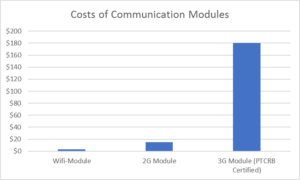
Costs:


ConnectedCrops cellular solution


Wi-Fi modules are 5% of the cost of a PTCRB certified 3G antenna.

So, why cellular?

Limited range:

We spoke with growers who told us about how important real-time data is to their operations.  If you’re running a serious operation, you need field-specific data.  The problem with a Wi-Fi station is that they had a limited range of 300 metres from an internet-connected Wi-Fi router, usually at the main farmhouse or barn.  Using repeaters wasn’t very helpful because power lines were needed for the repeater. It was useful to test the sensors, however weather data near the main farmhouse wasn’t a big deal, usually you knew the weather near the main location, it was the remote areas that you didn’t want to bother to drive to and check.  This was especially true for growers with multiple fields, some owned, some rented, and they needed better visibility at the remote locations.

Actual Costs:

The cost of the Wi-Fi module, although very small, required additional routers to be installed and configured.  We found several outdoor Wi-Fi routers that could be installed and powered using an ethernet cable; depending on the amount of weatherproofing you get with the router, the cost escalated quickly.  Best case, comparing all the costs, it looks like this:


ConnectedCrops cellular solution


Setting up and maintaining outdoor Wi-Fi requires technical know-how.  To set up an outdoor router is challenging for most people, configuring IP addresses, firewall security, power-level settings to control range, and antenna positioning to improve range.  We also learned that the router gets much less coverage in the summer when the foliage grows in.  We achieved 800 metres of range in the winter, but only 300 metres of range in a vineyard/orchard when the canopy had grown in.

2G Cellular

The best choice appeared to be a weather station with a 2G module.  It was the lowest cost and also provided the best flexibility in terms of range, power, and flexibility.  2G radios have a much less demanding power profile as compared to 3G radios.  There are some cellular stations on the market that are less costly, many of these units are 2G units and they use common frequencies: CDMA 850/1900 and EVDO 850/1900.

The reason we didn’t go with 2G units is very simple:  Cellular carriers are aggressively closing down their 2G network and expanding 3G, 4G LTE, and 5G support.  This means that the stations on the market will stop working as soon as the nearby towers are shut down, which means you have to buy a new product.  Depending on where you’re located, 2g will stop working:

 Sunset Date 
Canada  
TelusJanuary 31st  2017Reported
BellJanuary 1st  2017Reported
RogersDecember 31st 2018Reported
USA  
VerizonDec 21st  2019
AT&TDecember 31st   2016Announcement

The cellular carriers are all vague about when exactly 2G service will end.  The sunset schedule depends on when towers will physically be serviced as well as other long-term contracts, etc.  They will not authorize new devices to be deployed or serviced on 2G.

Conclusion

As a result of months of trials with growers, and ongoing conversations with carriers in Canada and the US, our results showed that Wi-Fi-based systems were very expensive and impractical for most growers, and 2G-based cellular units would stop working sometime in around 2017 if you’re in Canada and around 2019 if you’re in the US.

We found that, even at a more expensive module cost, 3G communications is the best solution for growers in the long term.

Critical lethal temperatures and growth stages for grape growers

As we enter into the bud break development period please refer to the following table for critical lethal temperatures and growth stages as vines are now reaching these developmental stages across Ontario.  This table provides guidelines for cold protection measures for grapes during this critical stage.

For optimal use of wind machines, it is suggested that the start-up temperatures be set at 2 to 3 degrees warmer than temperatures at which injury might occur. It is also important to monitor wind speeds along with temperatures.

Growth stage Critical temperatures Suggested Temperatures for start-up of wind machines
Dormant bud Minus 5 C (as of April 17, 2017) Minus 2 to Minus 3C
Dormant swollen bud Minus 3 C Minus 1  to 0 C
Bud Burst Minus 2.2 C 0 C to Plus 1 C
One leaf unfolded Minus 1.5 C Plus 1 C to Plus 2 C
Two or more leaves unfolded Minus 1 to 0 C Plus 1 C to Plus 2 C

Cold hardiness ratings are estimates only and the information provided is for general guidance. Cold hardiness ratings are site-specific and may vary based on vine health, viticulture practices, and site conditions, among other factors. Any decisions for protection strategies should be based on your own information and site conditions.  These guidelines are based on ongoing research at Brock and the team at CCOVI.

GROWER STORIES

ConnectedCrops Case Studies

4 ways in-field sensors can increase profits

Can the latest technology increase profit? The latest cellular weather stations provides real-time soil information and weather information directly to your phone; but how can you use this information to make more money? This article summarizes findings from University of California researchand Colorado State University research. Learn more about how you can apply these techniques yourself.

Can the latest technology increase profit? The latest cellular weather stations provides real-time soil information and weather information directly to your phone; but how can you use this information to make more money? This article summarizes findings from University of California research and Colorado State University research. Learn more about how you can apply these techniques yourself.


Moisture and Heat Stress – Silent Yield Robbers

Detecting moisture and heat stress are important steps to any effective irrigation management system. In the process of scouting your crops, you or the person doing it needs to understand some of the basics that exist with field moisture stresses and to be sure not to confuse them with heat stress.

Plant Stress in General:

Aside from, or in conjunction with physical injury, plant stresses which can lead to yield and/or quality loss happen as a result of either Biotic or Abiotic processes. Examples of Biotic effectors include insects and diseases. Abiotic effectors relate to chemical activity within the plant, including water. The presence of a biotic stressor on the plant results in the plant using its abiotic processes such as lignin production and metabolism to battle the ‘invader’. When the plant is predisposed to stress from abiotic barriers due to drought, chill, flooding, etc. it cannot respond to biotic stress as well. This is true across similar stressors within each causal group as well. For example, research has shown that a corn plant with anthracnose stalk rot is less likely to suffer economic yield loss if the presence of European Corn Borer is well below economic threshold, and its presence when corn borer is near threshold will accentuate the damage to the plant and increase yield loss even more. The same holds true with abiotic stressors. For example, when a plant takes up significant water during an active vegetative stage, and a drought period kicks in where the soil is approaching the wilting point, the stomata in the leaves will close as a protective mechanism, slowing metabolism. If extended for long, salts can accumulate in the plant and not be respired properly; resulting in salt injury and necrosis. Therefore, the interrelationship between water availability in the soil and plant metabolism is very important when focused on maximizing yield, quality, and plant health.

Heat Stress:

Heat stress is not the same as drought stress. It can be a serious condition in some areas of North America and on certain crops at certain times in their growth cycle. Like chilling stress, it involves the rapid slowing or even shutting down of some metabolic processes within the plant. Let’s examine some of the primary facts and factors relating to heat stress, according to The Prudent Garden (Garden Heat Stress, July 2016):

Sometimes we think that watering is the best response to Heat Stress…it is not always the answer! Many times you will see heat shock and stress when the soil is actually at acceptable moisture levels. Overwatering during Heat Stress can make the problem worse, especially if you’re not monitoring soil moisture and avoiding waterlogging the roots! Fungal diseases thrive in such conditions. The plant is shutting down (abiotic) due to heat and if you over water, you also introduce an opportunity for (biotic) pests and influencers to reduce yield potential even further. Watering should be done to only cool the plant and the environment around it when the soil is in adequate moisture status.

One of the more common diseases in tomato, pepper, squash, and others is blossom end rot. In summers when we have rapid heat accumulation plus inconsistent watering, this fungus will thrive. Technically caused by a calcium deficiency, the deficiency is actually caused when the soil goes from too dry to wet and back again in conjunction with heat stress. Adding calcium isn’t the answer, consistent soil moisture is.
Flower set and pollination are also affected by heat stress. If heat stress occurs in the bud stage, the plant may not even set flowers until cooler conditions prevail. If it occurs after the flowers are out and before pollination, they may just drop their flowers to protect themselves.

Drought Stress:

Drought stress can come on insidiously in crops. The plant responds to this abiotic stressor in different ways at different stages. Symptoms of drought stress are usually related to stomata response, whereby the respiratory organ of the leaf closes to retain water. Corn leaves curling onto themselves is a good example. Yield has probably already been lost once a plant is showing drought stress for several days on end. If the crop is near pollination, the yield and quality loss is even greater. In fruits, at fruit set, yield quality and tonnage can be extremely impacted.

The best way to prevent these stressors, whether biotic, or abiotic, is to provide consistent moisture at an optimum level throughout the season according to the plants needs at that point in time. Technology in wireless soil moisture monitoring, when combined with reliable data to estimate evaporation rate, soil texture effects, and crop needs; holds great promise for farmers who are scheduling irrigation to maximize yield.